
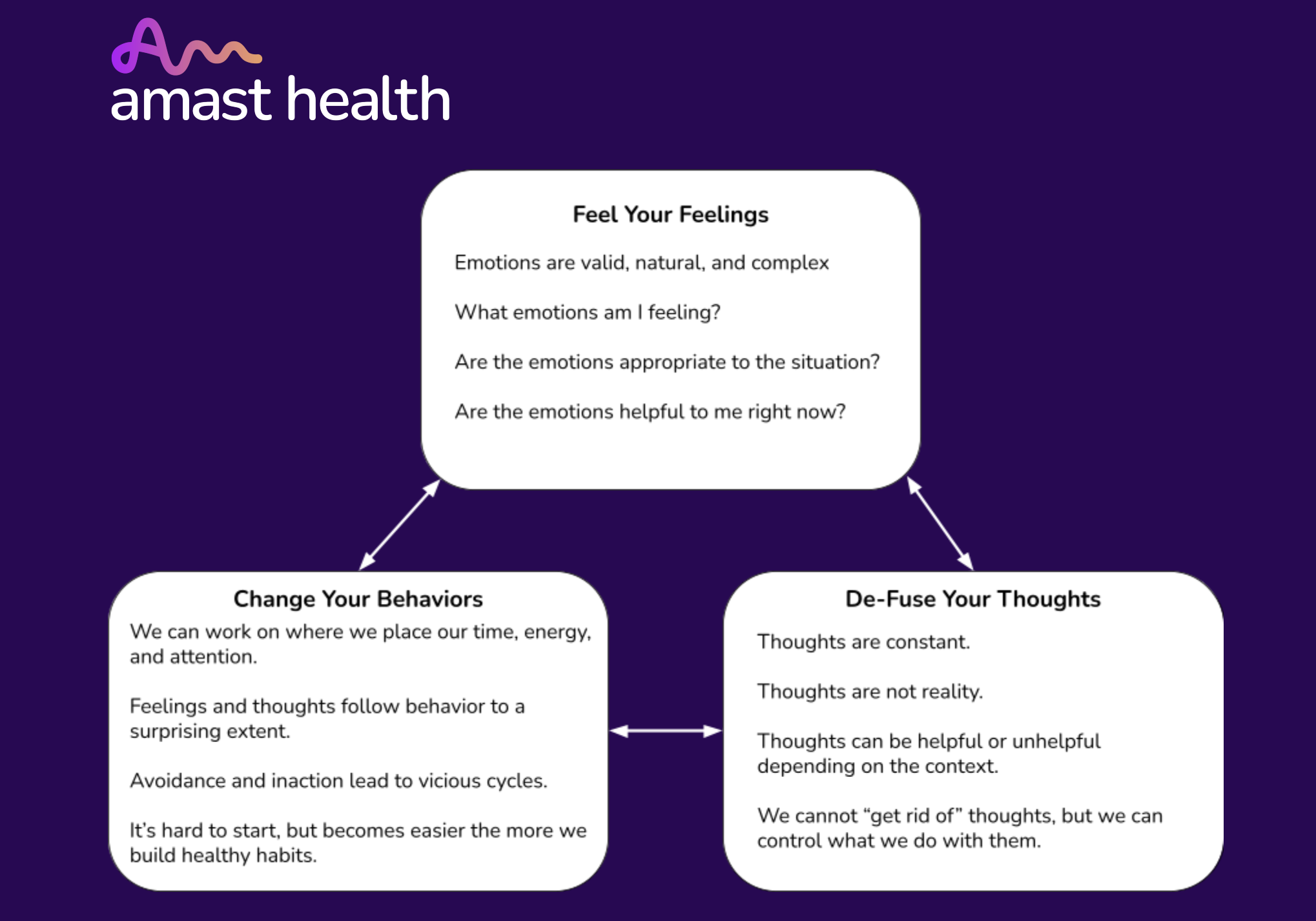
Feel your feelings
Emotions are valid: you are feeling what you are feeling (even if it is not necessarily appropriate to the situation or helpful to you at the moment).
Emotions are natural: they will come whether we want them to or not, and cannot be avoided forever.
Emotions are complex: not inherently good or bad, but they can be pleasant, painful, sticky, helpful, motivating.
One way to examine your emotions with curiosity is:
What emotion(s) am I feeling?
Is the emotion appropriate to the situation? If yes, is the amount of the emotion appropriate to the situation?
Is the emotion helpful to me (in this situation and in this amount)?
Emotions combine with thoughts to create stories that influence our behavior.
De-fuse your thoughts
Our brain is constantly generating thoughts, nearly 24/7, even while we sleep (in the form of dreams).
Thoughts are not reality – they can be random (like remembering a song stuck in your head), they can be bizarre (like dreams), they can be inaccurate (like a guess that later turns out to be wrong).
We can be very “fused” with our thoughts – they feel like they must be true, or that we must deal with them.
Like our emotions, they can be helpful or unhelpful to us depending on the context.
We are not trying to “get rid of” certain thoughts. We cannot fully control what thoughts pop into our head, and trying to not think about a thought often makes us think about it even more! What we can control where we direct our time, energy, and attention. This is hard to do, but it is a skill that we can train over time.
Change your behavior
Actions/behaviors are all we can really control (because thoughts and emotions are generated very quickly).
Where you choose to focus your attention, and how you react to a thought or emotion are all actions, even if nobody else can see it!
Choosing not to react to or focus on a thought or emotion is also an action!
Emotions and thoughts follow behaviors to a surprising extent.
Common sayings reflect this: “Fake it ‘til you make it”, “Just do it”.
One of the best treatments for depression is to act like a person who isn’t depressed.
It’s hard to change behavior - we know you’ve tried.
You logically know that it would be good for your health or you would feel better if you did certain things – like exercise more, reach out to friends, eat healthy, sleep better, etc. You probably don’t need us to tell you. Yet, if it were easy to do, you would have done it already.
It’s hard to do because sometimes avoidance and inaction feel easier, especially while you are depressed.
That avoidance and inaction lead to vicious cycles – avoidance can lead to feeling worse, having even less energy to do things, then doing even less.
How we help you at Amast:
Psychedelics as a catalyst: symptom relief + neuroplasticity.
Though the symptom relief they provide is temporary, this creates a window of opportunity for you to work on behavioral change that was harder to do before.
Neuroplasticity – there are biochemical effects happening in the background that help your brain break out of old habits and beliefs and allow for new learning.
Re-learning how to live healthy: every active step towards change yields something (exposure instead of avoidance, such that we retrain our brain to remember that these things bring us toward health).
Establishing routines and habits: they are hard to start, but become easier and easier the more we do them.
PDF Version: https://www.amasthealth.com/s/Therapy-Primer.pdf